

-
By sharareh
-
September 14, 2026
- 0 Comment
Air Conditioning
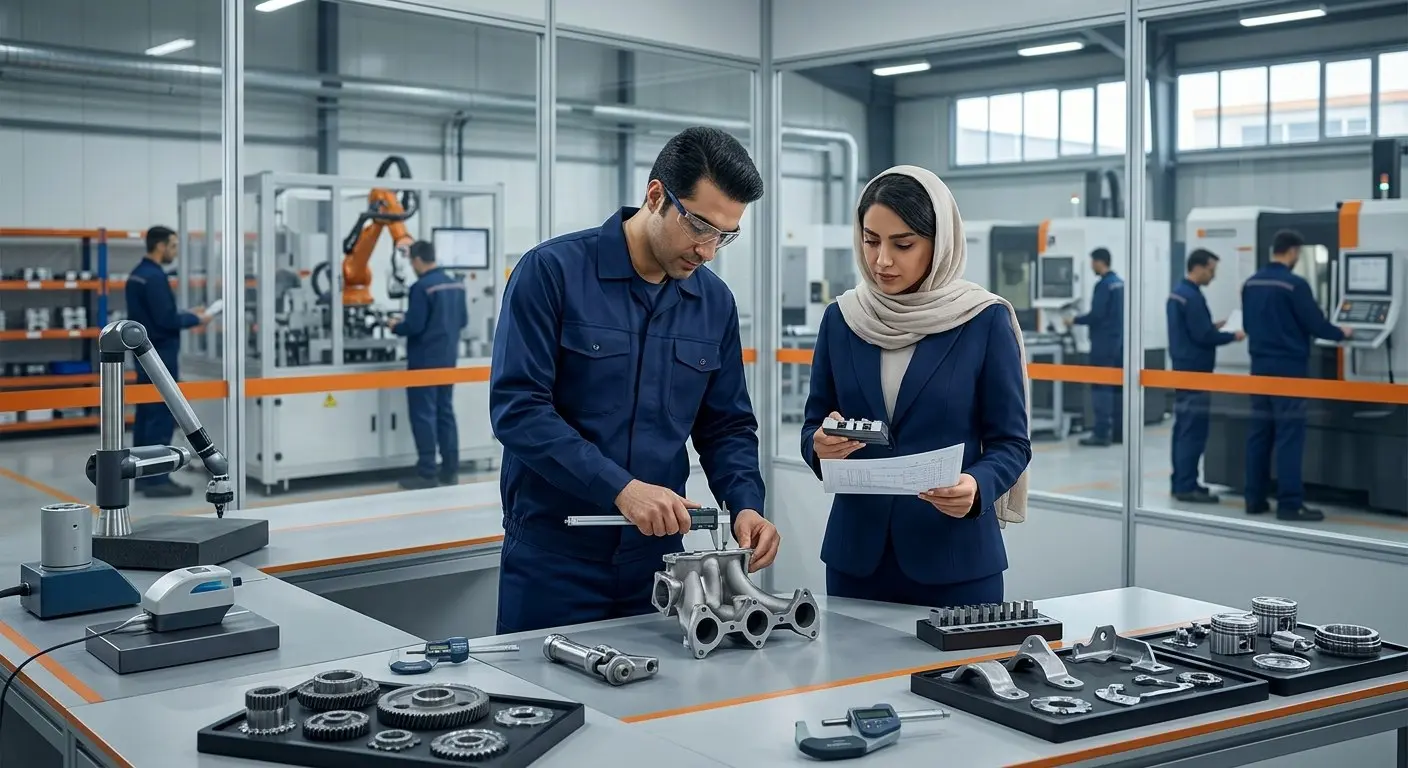
Integrated Solutions for the Automotive Industry
An automotive HVAC system is not simply a collection of individual components. Its performance depends on the interaction of heat transfer, fluid flow, sealing, connections, materials, component geometry, and manufacturing processes. Designing and manufacturing a reliable HVAC system therefore requires an understanding of both the product and the processes used to produce it.
At Apadana Dian Industrial Group, part of this chain begins with the production of aluminum tubes and profiles used in heat transfer and fluid-flow applications and extends through the design, manufacturing, assembly, and testing of automotive HVAC components. This interconnected capability allows automotive requirements to be considered across material, component, process, and performance.
Quick Link
Jump directly to key sections of this article for a faster overview.
Explore Our Capabilities
Discover Apadana Diyan’s integrated manufacturing capabilities, engineering expertise and industrial solutions.
Tube Manufacturing
Profile Development
Extrusion Processes
Surface Treatment
Combining Design, Precision, and Performance
Microchannel heat exchangers are an example of products in which geometric design and manufacturing processes have a direct relationship with final performance.
Channel geometry, flow paths, heat-transfer surface area, wall thickness, and manufacturability must all be considered together. For this reason, developing these products involves more than geometric design. Performance evaluation, testing, and analysis of results are also integral to the product development process.
At Apadana Dian Industrial Group, engineering and manufacturing capabilities related to aluminum tubes and profiles, combined with HVAC assembly manufacturing capabilities, provide the foundation for an interconnected chain in heat transfer and thermal management.
From Product Requirements to a Production-Ready Solution
Extrusion is one of the primary aluminum forming processes within this chain. In this process, a prepared billet is forced through a die under controlled conditions to produce the required profile geometry.
However, extrusion quality depends on far more than press capacity. Billet temperature, container and die temperature, extrusion ratio, press speed, cooling conditions, and die geometry are among the parameters that must be controlled according to the alloy and product specifications. Technical standards for solution treatment of extruded alloys likewise emphasize the importance of controlling key process parameters throughout extrusion and subsequent heat treatment.
Production Capacity and Flexibility
Product development creates industrial value only when the resulting design can also be manufactured consistently.
Sam Tahvieh Pasargad operates four specialized production lines supported by a combination of dedicated workstations and manufacturing processes. The company's stated two-shift operating capacity includes approximately 700 condensers, 500 evaporators, 400 heater cores, and 250 sets of connections per day.
This capacity, combined with production-line flexibility, supports a diverse product portfolio and a range of projects. The ability to adapt processes and prepare production lines for specific projects is particularly important for products with significant variation in vehicle models and technical specifications.
Production processes include fin forming, bending, pressing, torch welding, argon welding, and specialized assembly, selected according to the product type and construction.
The Details That Define Performance
In HVAC assembly manufacturing, accurate component forming is as important as the quality of the raw material.
Tubes and other components must be formed according to the required geometry and joined at defined locations. Bending, forming, joining, and assembly operations must be performed in a way that maintains dimensional requirements while preserving fluid-flow paths and overall system performance.
Manufacturing equipment delivers its full value only when it is integrated into a controlled and engineered process. For this reason, the connection between design, production planning, and quality control is a critical part of HVAC assembly manufacturing.
Controlling Joints in Heat Exchanger Manufacturing
Manufacturing
For certain HVAC assemblies and heat exchangers, the quality of the joints between components is particularly important.
The use of a fully electric brazing furnace at Sam Tahvieh Pasargad enables precise control of thermal conditions during the joining process. Controlled brazing parameters contribute to stable joints and help reduce the likelihood of joining-related defects.
The company's production infrastructure also includes hydraulic and mechanical presses ranging from 17 to 250 tons, together with dedicated forming, bending, and welding lines supporting the production of different HVAC products.
Verifying System Integrity
Sealing is one of the most important functional requirements in HVAC systems. A leak at a connection or elsewhere in the circuit can affect the performance of the entire assembly.
For this reason, leak testing is incorporated into the inspection process at Sam Tahvieh Pasargad. These tests are used to verify circuit integrity and confirm that the finished product is free from leakage.
Flow testing is also performed for relevant assemblies to evaluate fluid flow, while dimensional inspections verify component conformity with defined technical specifications.
These tests ensure that product evaluation is not based solely on appearance or dimensions, but also considers the functional performance expected from the assembly.
Testing Under Different Conditions
Automotive HVAC components are exposed throughout their service life to changes in temperature, pressure, and environmental conditions. Their performance therefore needs to be evaluated in conditions relevant to their intended application.
Within Apadana Dian Industrial Group's testing infrastructure, capabilities include hydrostatic pressure testing, pressure and pressure-cycle testing, temperature testing under hot and cold conditions, and salt spray testing.
These tests can provide information on the behavior of components such as condensers, evaporators, tubes, and connections under different operating conditions and can be used as part of product development and quality control.
The Direction of Sam Tahvieh Pasargad
The R&D function at Sam Tahvieh Pasargad focuses on new product development and localization alongside the improvement of existing products.
One defined direction is the transition from manufacturing individual components toward the design and development of complete automotive air-conditioning systems. This path brings together thermal design, reverse engineering, performance analysis, material selection and improvement, and the development of application-specific projects.
Extending product service life and improving performance are also part of the development agenda. Achieving these objectives requires continuous interaction between engineering, manufacturing, testing, and feedback from products in operation.
Connection to the Automotive Industry
Sam Tahvieh Pasargad's products serve both the automotive aftermarket and projects within the broader automotive supply chain.
Collaboration with organizations including Crouse, Kerman Motor, Iran Khodro Diesel, Saze Gostar and MVM represents part of the company's engagement with the automotive industry. Its product portfolio also covers a range of high-volume vehicle applications and specialized projects.
This type of engagement requires the ability to respond to product variety, technical specifications, production volumes, and quality requirements factors that directly shape the company's engineering and manufacturing structure.
From Heat Transfer to Thermal Management
Apadana Dian Industrial Group's capabilities in thermal management can be viewed as an interconnected chain. It begins with the production of tubes and profiles used for fluid flow and heat transfer, extends into the design and manufacturing of HVAC assemblies, and is completed through testing, quality control, and product development.
Within this chain, Rayan Mobadel Pishro contributes material and component capabilities for fluid flow and heat transfer, while Sam Tahvieh Pasargad leverages its engineering function, production lines, and testing infrastructure to manufacture a range of automotive HVAC assemblies.
The result is not simply the production of a condenser, evaporator, or tube. It is the development of an engineering capability for addressing thermal management requirements across the automotive industry.
For Apadana Dian Industrial Group, HVAC is not a single product. It is a connected chain that brings together materials, heat transfer, design, manufacturing, joining, testing, and product development—creating a defined and controllable path from an initial concept to a functional, production-ready solution.