

for the Automotive Supply Chain
The automotive industry is built around a complex network of interconnected components and systems, where overall vehicle performance depends on how effectively these elements work together. From aluminum components and connectors to thermal management systems, machined parts, and mechanical assemblies, every component must meet defined technical requirements while also being suitable for stable and repeatable production.
For this reason, manufacturing an automotive component involves far more than producing a specific shape from a metal or raw material. Engineering design, material selection, manufacturability, tooling and fixture design, process planning, dimensional control, validation, and documentation all form part of the journey from an automotive requirement to an industrial product.
At Apadana Dian Industrial Group, capabilities across aluminum, forming, machining, thermal management systems, electronic components, and engineering services come together to support different stages of this supply chain.
Quick Link
Jump directly to key sections of this article for a faster overview.
Explore Our Capabilities
Discover Apadana Diyan’s integrated manufacturing capabilities, engineering expertise and industrial solutions.
Performance-Driven Design
Advanced Engineering Tools
Design for Manufacturability
Production-Ready Development

Where Does an Automotive Component Begin?
An automotive component project typically begins with a defined technical requirement: an engineering drawing, prototype, existing component, functional specification, or a manufacturing challenge that requires a practical production solution.
At this stage, understanding the component in detail is essential. Material and alloy, dimensions, tolerances, mechanical properties, operating conditions, connection points, manufacturing process, and quality requirements must all be evaluated together.
In some projects, the component is developed from the outset based on an engineering drawing. In others, an existing physical component becomes the starting point for reverse engineering. In both cases, the objective is the same: to transform a technical requirement into an engineering definition that can be manufactured.
Turning a Physical Component into Manufacturing Knowledge
A significant number of automotive projects involve components for which a physical sample exists, while complete drawings or original design data are not available.
In such cases, reverse engineering provides a structured path for converting the physical sample into engineering information. Component geometry, dimensions, functional surfaces, connection points, and critical features are examined to develop the models and technical documentation required for production.
This process becomes particularly valuable when the objective is not simply to reproduce an existing component, but to improve it or transfer it into a stable and repeatable manufacturing process.
At this stage, manufacturing experience and process knowledge can be combined with information obtained from the physical sample to create a component that is both manufacturable and controllable.
From Aluminum to Engineered Components
Aluminum is an important material within the automotive component supply chain, particularly in applications where weight reduction, formability, thermal conductivity, and suitable resistance to operating conditions are important.
The Group's capabilities in aluminum production and product development—from billet production and extrusion to heat treatment, drawing, straightening, and quality control—provide part of the material and profile requirements for industrial and automotive projects.
However, an aluminum product does not always enter the vehicle directly. Depending on its application, it may subsequently require cutting, bending, drilling, machining, joining, or assembly into a larger component.
It is this connection between material production, forming, and component manufacturing that creates the potential for a more coherent and efficient value chain.
Transforming Raw Components into Precision Components
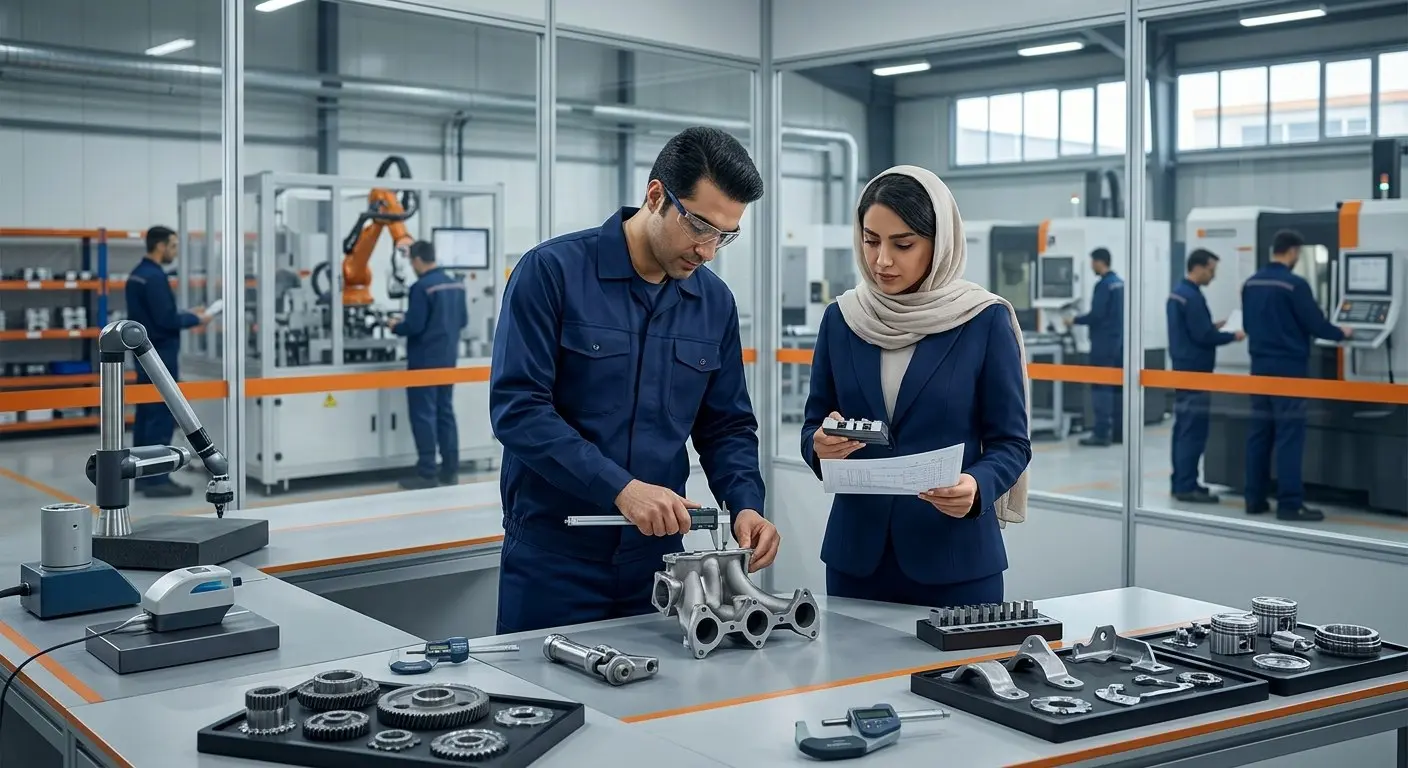
A significant proportion of automotive components feature precise surfaces, holes, slots, and dimensional requirements that can only be achieved through controlled machining processes.
Depending on component geometry and technical requirements, CNC machining, milling, turning, drilling, and finishing operations can be incorporated into the manufacturing process.
Beyond machining itself, toolpath planning and the generation of appropriate machining code are also critical. CAM software such as PowerMill and SolidCAM can be used to prepare machining strategies for complex components and optimize the manufacturing process.
The ultimate objective is not simply to produce the correct geometry, but to consistently achieve the defined dimensions and tolerances throughout production.
An Integral Part of Manufacturing Engineering
In automotive component manufacturing, production tooling and fixtures are integral parts of the process.
A properly designed fixture can securely position a component during machining or inspection, helping reduce setup time while improving accuracy and repeatability. For this reason, the design of tools, molds, punches, dies, and fixtures must be aligned with the component geometry and manufacturing method.
This becomes particularly important as production volumes increase, when even small changes in cycle time or scrap rate can have a significant impact on manufacturing economics.
At Apadana Dian Industrial Group, tooling design and manufacturing capabilities are positioned alongside forming, machining, and component manufacturing processes, enabling part of the tooling requirements within this chain to be addressed internally.
Making Decisions Before Production
As component geometry becomes more complex and performance requirements increase, direct trial and error on the production line becomes increasingly costly.
For selected automotive component development projects, CAE analysis can provide valuable insight into component behavior under different conditions before a physical prototype is manufactured.
At Pasargad Khodro Khazar, ANSYS and Abaqus are used for analyses including stress and strain, impact and crash, fatigue, forming and deformation, as well as studies related to topology optimization.
These analyses can help answer questions during the design stage that might otherwise only become clear after a prototype has been manufactured and tested.
For example, is the current component thickness appropriate for the required loading conditions? Can component weight be reduced without compromising performance? Can the proposed geometry withstand its intended operating conditions?
Addressing such questions before production can reduce the number of design and prototyping iterations and help shorten the development cycle.
Responding to Automotive Product Variety
The automotive supply chain does not always operate around a single fixed product and a completely uniform order pattern. Product variety, model changes, new projects, and different customer requirements can all create a need for manufacturing flexibility.
Under these conditions, the ability to change machine setups efficiently and reconfigure machining stations becomes increasingly important. Multi-purpose fixtures and process designs adapted to different components can enable more flexible use of available production capacity.
At Pasargad Khodro Khazar, this flexibility is supported by CNC machinery as well as cutting, pressing, drilling, and machining equipment for the production of diverse automotive components.
Such an approach helps manufacturers balance product variety, production capacity, and quality requirements.
From Components to Assemblies
In the automotive industry, many finished products are not individual components but assemblies made up of multiple elements that must work together to deliver a defined function.
For example, within thermal management systems, aluminum components, tubes, connectors, and heat exchanger elements are ultimately used together as part of an integrated assembly. In other applications, machined components, formed parts, and connecting elements must also be assembled within defined dimensional and functional requirements.
The value of component manufacturing therefore increases when the relationship between individual components and the final assembly is considered from the beginning.
At Apadana Dian Industrial Group, the proximity of aluminum production, machining, automotive component manufacturing, and thermal management capabilities provides an opportunity to establish such connections across parts of the supply chain.
Part of the Design, Not the Final Step
In automotive component manufacturing, quality should not be treated solely as a final inspection activity. Quality requirements need to be incorporated into the project from the design and process-planning stages.
Dimensional requirements, material specifications, mechanical properties, inspection points, test methods, and acceptance criteria should be defined from the outset. Throughout production, process data and inspection results should then be recorded and maintained as traceable information.
Approaches such as APQP, together with automotive and quality management system requirements, provide a more structured framework for product and process development. Within this framework, projects can be managed from requirements definition and feasibility assessment through prototyping, validation, production preparation, and documentation.
This structure helps ensure that final product quality is the result of a series of engineering and process-control decisions rather than the outcome of a final inspection alone.
Building Better Components
Automotive component development does not end with the first successful production run. Manufacturing data, test results, and field feedback can provide valuable input for continuous improvement of both products and processes.
Weight reduction, improved manufacturability, reduced scrap, greater repeatability, geometry optimization, improved machining processes, and the development of new manufacturing methods can all become part of an ongoing R&D program.
For new projects, the combination of reverse engineering, modeling, simulation, tooling design, prototyping, and testing can transform an industrial idea or requirement into a manufacturable product.
The value of this process increases when the outcome is not limited to a laboratory prototype, but can ultimately be transferred into series production.
From Automotive Requirements to a Production-Ready Component
An automotive component creates value within the supply chain when it can simultaneously meet a range of requirements: technical performance, manufacturability, consistent quality, controlled cost, and repeatability.
At Apadana Dian Industrial Group, capabilities in engineering design, reverse engineering, simulation, aluminum production, forming, machining, tooling, component manufacturing, and quality control are brought together across different stages of the development and manufacturing chain.
These capabilities help create a pathway in which component development can begin with a technical requirement or specification and progress through design, feasibility assessment, process selection, tooling, prototyping, testing, and production to become an industrial product.
Ultimately, the objective of working in automotive components is not simply to manufacture individual parts. It is to develop the engineering and manufacturing capabilities required to respond to the diverse needs of the automotive supply chain—a supply chain in which quality, precision, manufacturability, and continuous development are all integral to the definition of the product.