

Machining Processes for Industrial and Automotive Components
Machining is one of the most important manufacturing processes for engineered components. It involves transforming raw or semi-finished material into the required final geometry and dimensions through operations such as turning, milling, drilling, and controlled material removal.
For industrial and automotive components, machining is not simply about achieving a specific shape. Many functional features of a component—from the precise location of holes and mating surfaces to diameters, grooves, tolerances, and concentricity—depend directly on machining accuracy.
Machining therefore becomes a true industrial capability only when design, process planning, tool selection, fixturing, machine selection, cutting parameters, and dimensional inspection are managed as part of a coordinated process chain.
At Apadana Dian Industrial Group, machining capabilities are integrated with areas such as aluminum processing, forging, automotive components, and engineering services, enabling raw and semi-finished components to be transformed into precision-engineered products that meet defined technical requirements.
Machining Does Not Start with the Machine
A common assumption is that machining quality depends primarily on the machine itself. In reality, the machine is only one element of the overall process.
Before a component is placed on the machine, it must be determined how much material needs to be removed, what the sequence of operations will be, how the component will be positioned and secured, which tools will be used, and how the toolpath will be defined.
For complex components, even an inappropriate sequence of operations can lead to deformation, dimensional errors, or limited tool access to critical surfaces.
For this reason, the machining process begins with engineering and process planning before moving to the physical execution of machining operations.
Quick Link
Jump directly to key sections of this article for a faster overview.
Explore Our Capabilities
Discover Apadana Diyan’s integrated manufacturing capabilities, engineering expertise and industrial solutions.
3D Model Development
CAM & Toolpath Preparation
Machining Strategy Definition
Complex Process Optimization

Precision with Repeatability
CNC machining enables production programs to be executed with precise control over tool and component movement.
This capability is particularly important for components with defined tolerances or for products that must be manufactured repeatedly with consistent geometry.
In CNC machining, the program, cutting tool, machining conditions, fixture, and machine condition must all be controlled together. The objective is not simply to produce one accurate component; the process must be capable of reproducing the same characteristics consistently across subsequent production runs.
This is particularly important in automotive manufacturing, where each component must interface correctly with other components and fit into the assembly process without difficulty.
Turning Alloy into Engineered Profiles
Extrusion is one of the primary aluminum forming processes within this chain. In this process, a prepared billet is forced through a die under controlled conditions to produce the required profile geometry.
However, extrusion quality depends on far more than press capacity. Billet temperature, container and die temperature, extrusion ratio, press speed, cooling conditions, and die geometry are among the parameters that must be controlled according to the alloy and product specifications. Technical standards for solution treatment of extruded alloys likewise emphasize the importance of controlling key process parameters throughout extrusion and subsequent heat treatment.
Controlling Rotational Geometries
Turning is one of the primary machining processes for components with rotational geometries.
Depending on the component design, external and internal diameters, grooves, steps, threads, and cylindrical surfaces can be produced through turning operations.
Within the Group’s industrial operations, CNC and conventional turning equipment are used alongside other manufacturing processes. The appropriate process depends on production volume, component complexity, required accuracy, and manufacturing conditions.
For repetitive production, CNC turning can improve process consistency and repeatability, while conventional machines continue to provide value for certain repair, adjustment, and production applications.
For More Complex Geometries
Milling becomes particularly important when a component includes flat surfaces, slots, cavities, steps, complex forms, or other features that cannot be produced through turning alone.
In industrial and automotive components, milling can be combined with drilling and other processes to transform a raw component into a finished product with multiple precision features.
In such processes, accurate component positioning is critical. If the component is not correctly located and secured in the fixture, even an accurately executed CNC program may not produce the required result.
For this reason, fixturing and workholding methods are an integral part of machining process engineering.
The Foundation of Process Repeatability
A fixture holds the component in a defined and stable position so that manufacturing or inspection operations can be performed with the required accuracy.
In automotive production, a well-designed fixture can reduce machine setup time, maintain consistent component positioning across production runs, and reduce the risk of operator-related errors.
In some projects, fixtures must accommodate multiple component variants, allowing a single production station to be used more flexibly.
This is particularly valuable in manufacturing environments where product variety and changing orders require a balance between production flexibility and dimensional consistency.
Small in Size, Critical in Impact
Selecting the appropriate cutting tool is one of the key factors affecting both machining quality and process economics.
Material type, hardness, component geometry, cutting depth, speed, and production conditions can all influence tool selection.
An unsuitable tool can increase wear, reduce surface quality, extend production time, or even damage the component. Conversely, selecting the right tool and machining parameters can improve tool life and contribute to process stability.
Machining process planning therefore involves more than defining toolpaths. Tool selection and the conditions under which each tool is used are equally important parts of the engineering process.
Machining Aluminum Components
A significant proportion of the components manufactured across the Group’s production chain are made from aluminum alloys. While aluminum offers advantages such as low weight and good machinability across many alloys, machining aluminum still requires careful attention to cutting conditions and process control.
Components initially produced through extrusion or forging may subsequently undergo machining to create their final functional features.
For example, a forged component may achieve its primary geometry through the forging process but still require machining to produce precise holes, mating surfaces, or dimensional tolerances.
In such cases, the initial component design and forming process must be developed from the outset with the final machining operations in mind.
From Near-Net Shape to Finished Component
In forging, the primary objective is to produce a geometry close to the final shape while achieving the required material properties. However, many of the component’s precision features are created during subsequent machining.
The relationship between forging and machining is therefore an important consideration in process design.
If excessive machining allowance is provided, production time and cost increase. If the allowance is insufficient, achieving the required final dimensions may become difficult.
For this reason, die design, machining allowance, forging sequence, and machining strategy should be evaluated together as part of a coordinated manufacturing process.
Machining in Automotive Components
In the automotive industry, many components require a combination of forming and machining processes.
Aluminum components, connections, thermal-system components, and mechanical assemblies may undergo machining after their initial forming stage to achieve precise dimensions and functional features.
At this stage, the ability to manufacture different component types with appropriate process configurations becomes important. Rapid setup changes, suitable fixtures, and the ability to prepare machining programs for different components provide greater flexibility in responding to diverse production requirements.
At Pasargad Khodro Khazar, CNC machines are used alongside turning, milling, drilling, cutting, and other production equipment, supporting the manufacture of different components through a range of machining processes.
A Two-Way Connection
Machining is not limited to the production of final components. Many manufacturing tools themselves require precision machining.
Depending on their design, molds, punches, dies, production fixtures, and inspection fixtures may all require machining operations.
When machining capabilities are available alongside tooling design and manufacturing, the product development cycle can be shortened.
Engineers can design tooling based on the actual capabilities of the machining process, while production-related issues can be addressed and tooling modifications implemented more efficiently when required.
Verifying Machining Accuracy
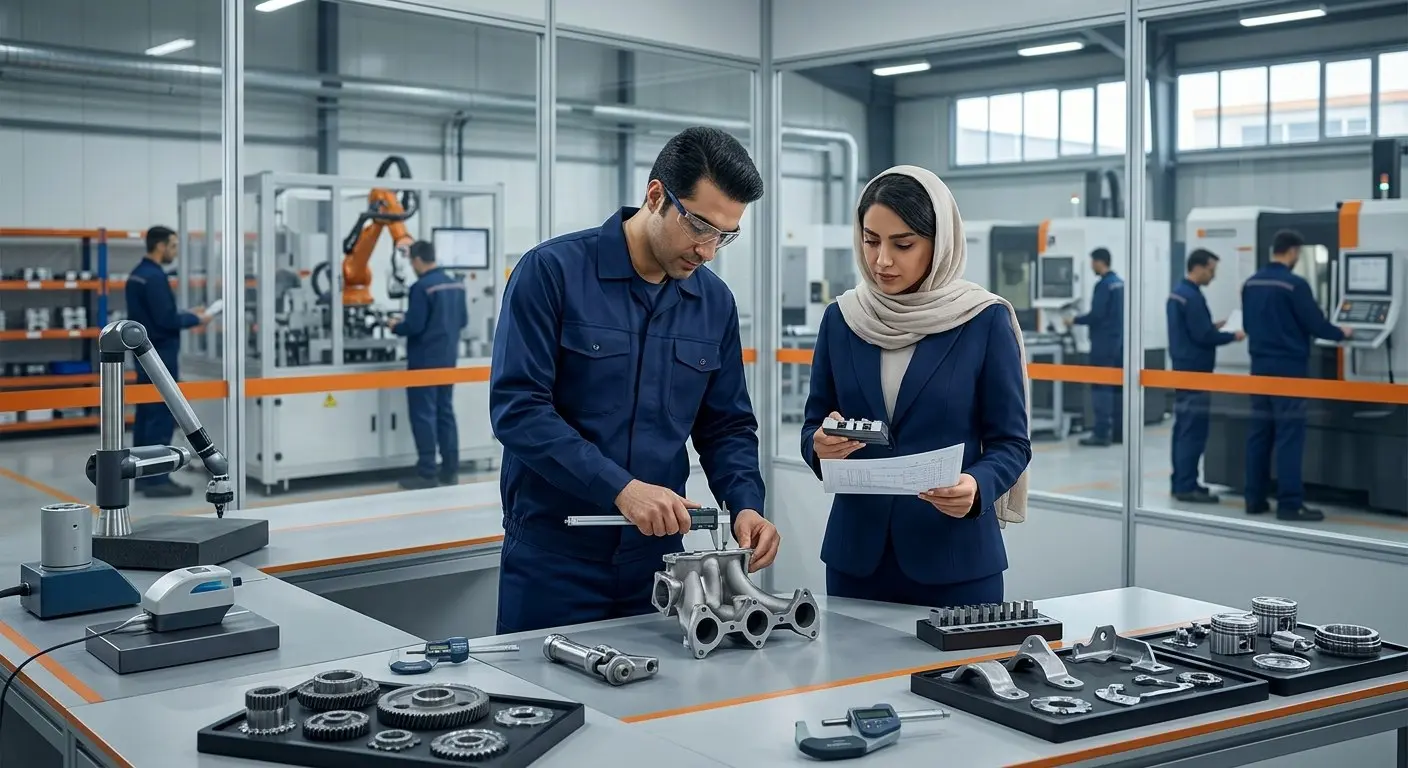
Machining is successful only when the resulting component is compared against and verified against its engineering specifications.
Diameters, lengths, hole locations, angles, distances, and other geometric features can be inspected using appropriate measurement equipment.
For simple components, some measurements can be performed using conventional handheld instruments. For more complex geometries or features that cannot be measured directly, advanced equipment such as VMM/CMM systems becomes increasingly important.
Within the Group’s quality-control infrastructure, dimensional inspection is used to evaluate profiles, multi-channel products, and components whose critical features cannot be adequately measured using calipers or other conventional tools.
These inspections make it possible to compare actual machining results with engineering drawings and defined requirements.
The Bridge Between Design and Series Production
One of the important applications of machining is prototype manufacturing.
Before a component enters series production, a prototype may be required to evaluate dimensions, assembly, functionality, or performance through testing.
CNC machining can provide valuable flexibility at this stage, allowing prototypes with geometry close to the final product to be manufactured without the need to establish a complete production line.
The results obtained during prototyping can then feed back into the design process. Where necessary, the component geometry, fixture, or manufacturing sequence can be modified before moving toward production.
From Production Data to Process Improvement
Machining is not a fixed process that remains unchanged over time. Tool wear, material variation, changes in production volume, and quality-control feedback can all indicate that process adjustments are required.
Analysis of production data can help identify issues such as increased cycle time, higher scrap rates, or dimensional variation.
Corrective actions may include modifying the CNC program, changing the toolpath, improving the fixture, selecting a different cutting tool, or adjusting process parameters.
This continuous cycle transforms machining from a purely execution-based operation into a process that can be systematically improved and developed.
Flexibility as Part of Machining Capability
Industrial projects are not all the same. Some components require high-volume production, while others are manufactured in limited quantities or developed as new and customized projects.
A combination of CNC and conventional machines, together with cutting, milling, turning, drilling, and tooling capabilities, provides greater flexibility in selecting the most appropriate manufacturing approach.
This flexibility is particularly valuable for an organization working across both automotive and industrial projects, where component type, production volume, required accuracy, and delivery time can vary significantly from one project to another.
Machining as Part of an Engineering Chain
At Apadana Dian Industrial Group, machining is not defined as an isolated manufacturing operation. It is connected to design, reverse engineering, forging, extrusion, tooling, quality control, and product development.
A component may begin with a 3D model, followed by machining process and toolpath development, fabrication of the required tooling and fixtures, CNC machining, and dimensional inspection.
In development projects, production results can also be fed back into the design stage and used to improve either the product or the manufacturing process.
Ultimately, the objective of machining is not simply to remove material from a component. It is to transform raw or semi-finished material into a precise, repeatable product that meets defined engineering requirements.
This perspective makes machining a key link in the industrial manufacturing chain—one in which precision, process engineering, tooling, quality control, and repeatability are closely interconnected.